Dynamic Evolution of Fire Weather Risk
Wildfire risk is changing spatiotemporally on a global scale due to growing fire weather risk. Days when weather conditions exceed a high-danger threshold are quantified as "Synchronous Fire Weather" (SFW) days — and these are increasing globally.
Full paper coming soon!
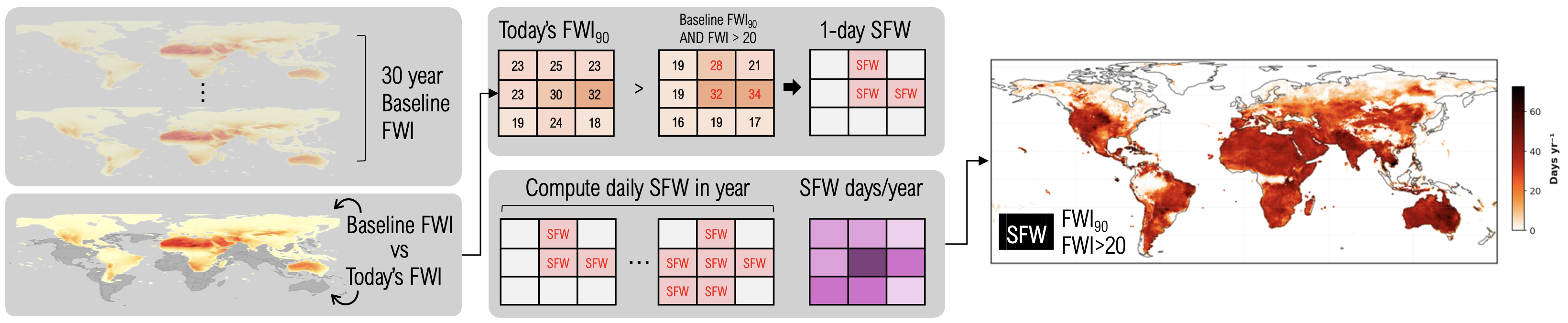
Synchronous Fire Weather (SFW) defines concurrent climate extremes or spatially compound events which can significantly intensify hazards and exacerbate impacts. SFW is measured as the average number of days per year where local weather conditions exceed a high-danger threshold.
This threshold is derived from a 30-year baseline climatology of the Fire Weather Index (FWI) — a composite meteorological metric combining temperature, humidity, wind speed, and drought codes to estimate fire danger.
Three severity levels are assessed: severe (FWI90), extreme (FWI95), and catastrophic (FWI99) conditions, based on the 90th, 95th, and 99th percentile of the 30-year baseline at each grid cell.
"If a fire season is increasing and eventually overlapping, it will shrink the window of opportunity to help each other in terms of firefighting."
We focus on a 24-year time period from 2002 to 2025. For each grid cell, the historical FWI distribution is derived from a 30-year baseline (1991-2020). Each daily FWI value is compared against its baseline threshold (e.g., FWI calculated at the 90th percentile). Days exceeding the threshold are counted as "SFW" days and averaged per year to yield an annual average number of days.
SFW can be computed with respect to severe, extreme, and catastrophic thresholds of FWI (FWI90, FWI95, FWI99). The percentile values are determined per grid cell at 0.25-degree resolution (baseline FWI). Since we measure at each grid cell, we map SFW days globally (e.g., Global map of SFW days for FWI at the 99th percentile and FWI is greater than 20)
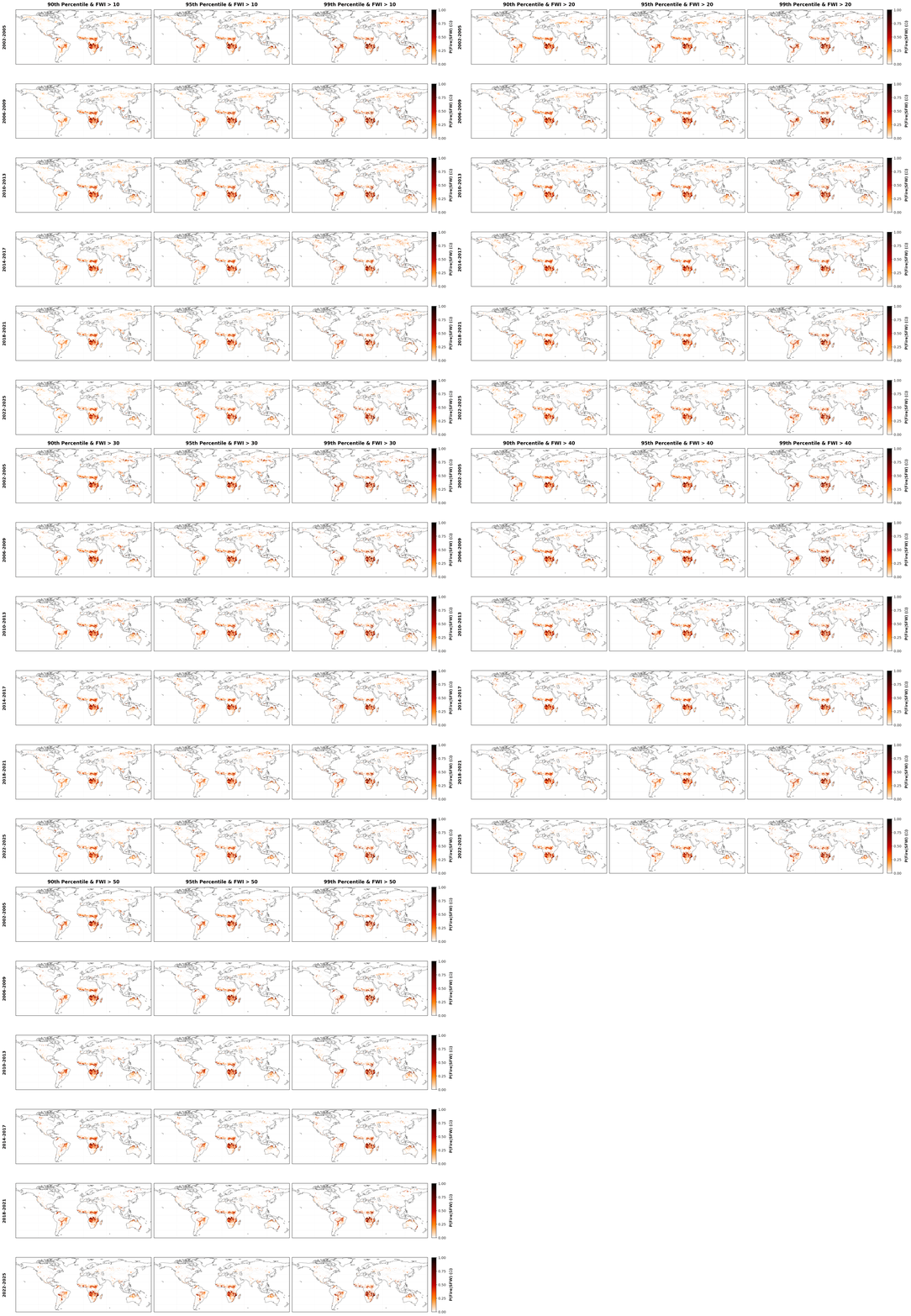
Are fires really occurring during SFW days? To answer this question, we compute the conditional probability of fire occurrence given SFW days (FWI at 90, 95, 99 percentiles) when average FWI is greater than specific values (10, 20, 30, 40, 50).
We compute fire occurrence by using individual fire perimeters from the Global Fire Atlas (area > 1 sq. km) excluding urban and agricultural areas. Then, for each grid cell, we compare fire occurrences on SFW days over the year to compute this conditional probability metric.
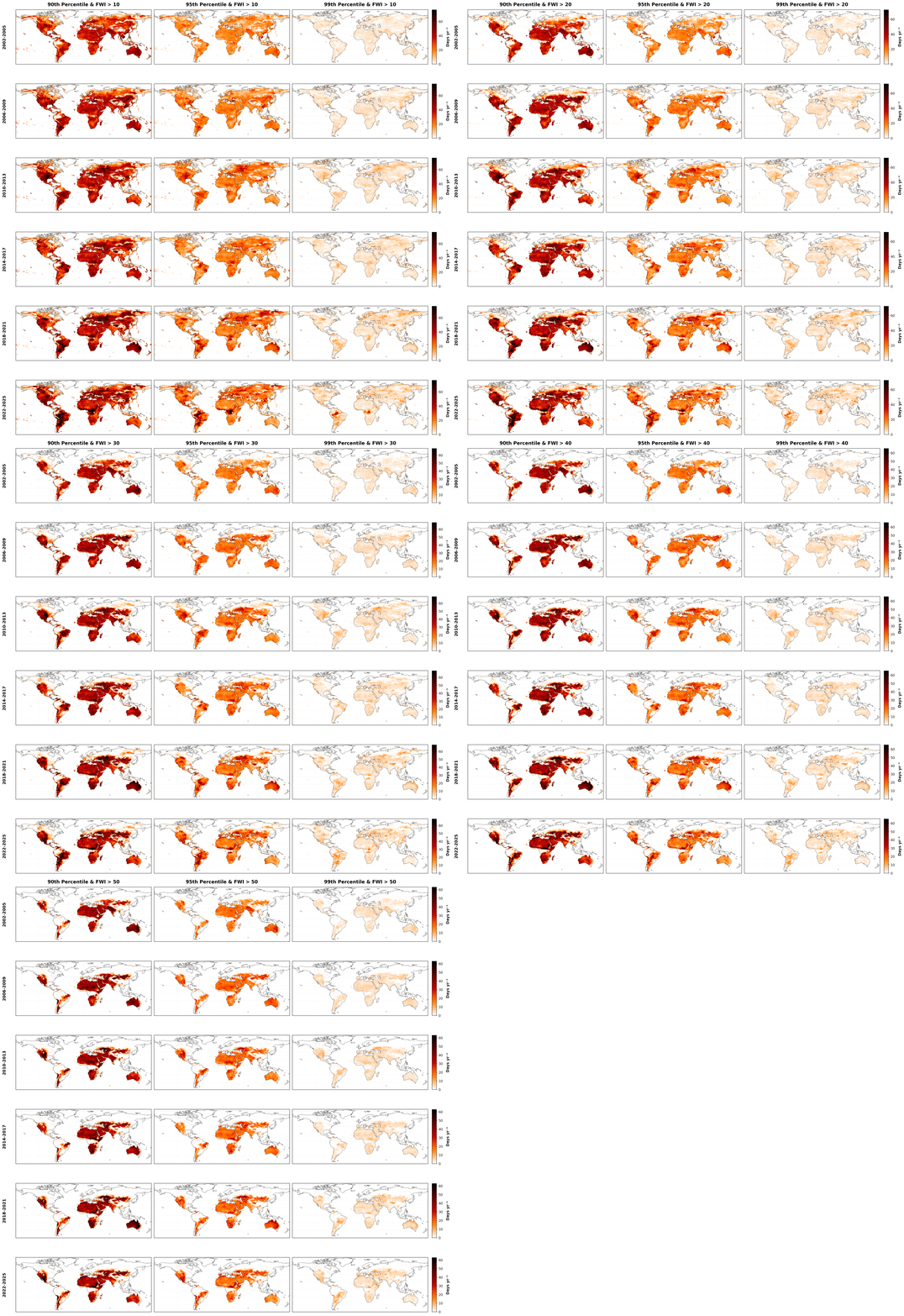
We observe that the average annual SFW days tend to increase globally over time. At higher absolute FWI values, the majority of SFW days occur in the Western US, S. America, Africa, Mediterranean Europe, Australia, and Southeast Asia. At higher FWI percentiles, the number of SFW days decreases indicating a smaller window of opportunity for fire weather conditions to occur.
While SFW days are observed globally, fires do not always occur under SFW days nor in the regions with SFW. Higher probability values are found to be in Africa, S. America, Australia, Southeast Asia, Eastern Europe and Russia. We also observe high probability values in the northern latitudes in N. America and Russia.
Increasing synchronicity of severe fire weather conditions brew the "perfect storm" for extreme wildfires which may emerge in unexpected regions and cause more disproportionate impacts if unprepared.
References:
Jones et al. (2022). Global and regional trends and drivers of fire under climate change. Reviews of Geophysics, 60(3).
Yin et al. (2026). Increasing synchronicity of global extreme fire weather. Science Advances, 12(8), eadx8813.