Fighting Fires with Fire Potential Risk Networks
As fires grow more extreme and complex, proactive risk-informed strategies are imperative. We collaborated with the Catalan Fire Service (Spain) to automate fire potential polygon generation and deploy the model in real wildfire operations.
Read the full paper here.
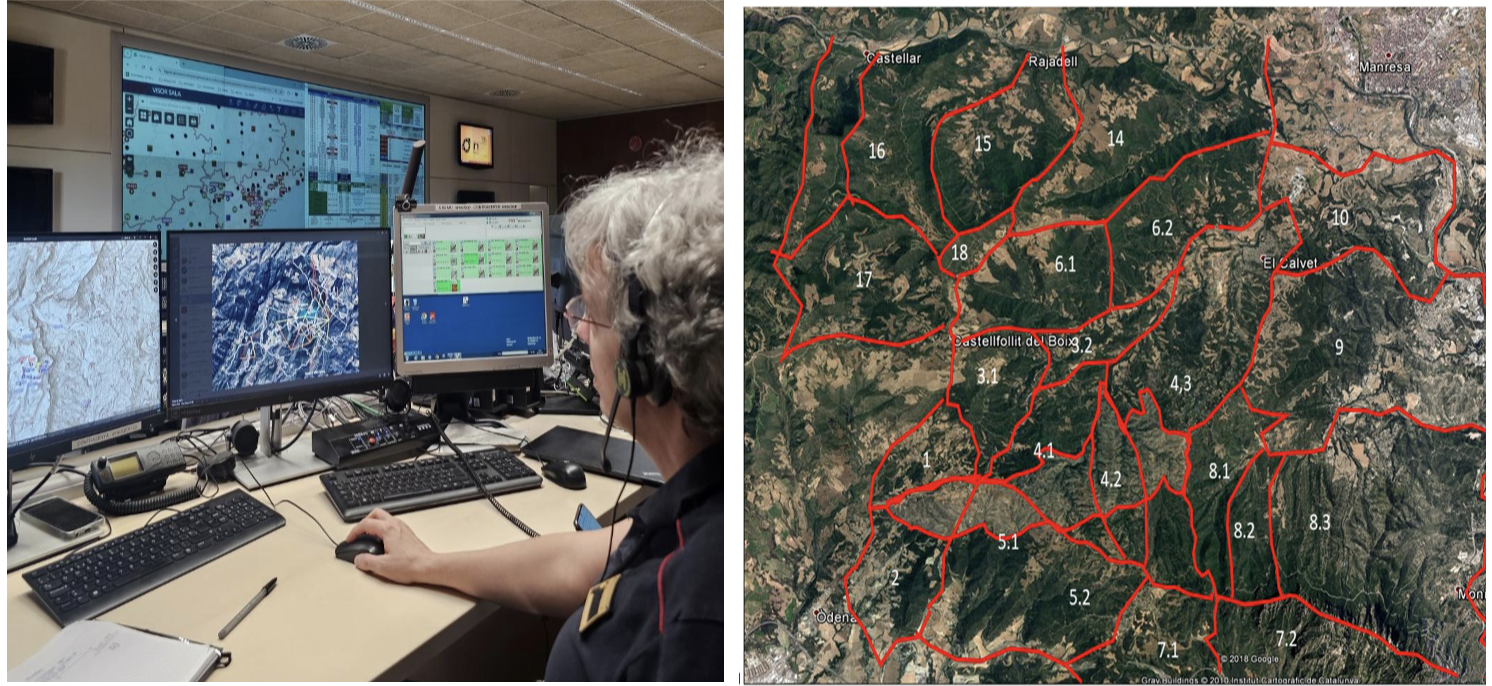
Current risk management approaches rely on manual drawing of risk management zones and expert judgment on fire behavior. Fire potential polygons (FPPs) are drawn by analysts on the landscape for risk management, which is a tedious process requiring high expertise and introduces drawing bias. We collaborated with the Catalan Fire Service to automate and streamline the risk management process by coupling fire spread simulation with hydrology-inspired polygon delineation. The model was then deployed in real wildfire operations to empower fire suppression tactics and decision-making.
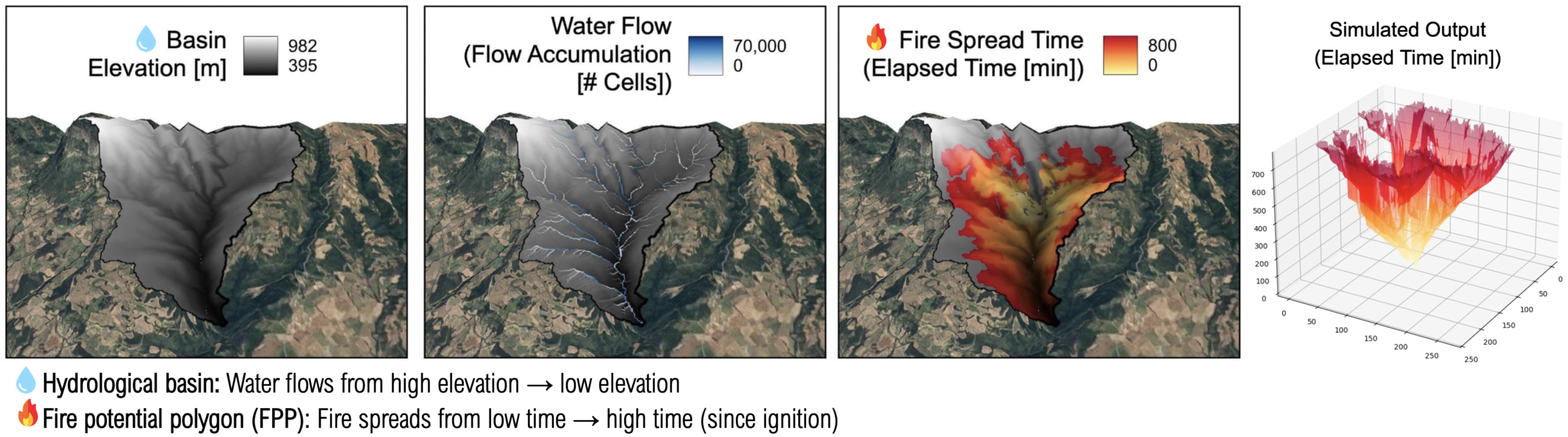
The key insight: fire spread behaves analogously to water flow. Similar towater flowing from high elevation to low elevation (forming hydrological basins), fire spreads from points of ignition to points of later arrival time. By treating fire spread "time" like an inverted elevation surface, we adapt a basin delineation algorithm to automatically generate Fire Potential Polygons (FPPs).
The process: (1) Run Cell2Fire simulation → (2) Generate elapsed time surface → (3) Compute flow direction using D8 algorithm → (4) Extract "reversed basins" as FPPs. The resulting polygons capture the natural fire spread pathways across complex terrain.

The case study compared four suppression strategies alongside a prescribed burn, in response to socio-political pressure from local government to protect farmland and nearby towns (Artesa de Segre, population 3,447).
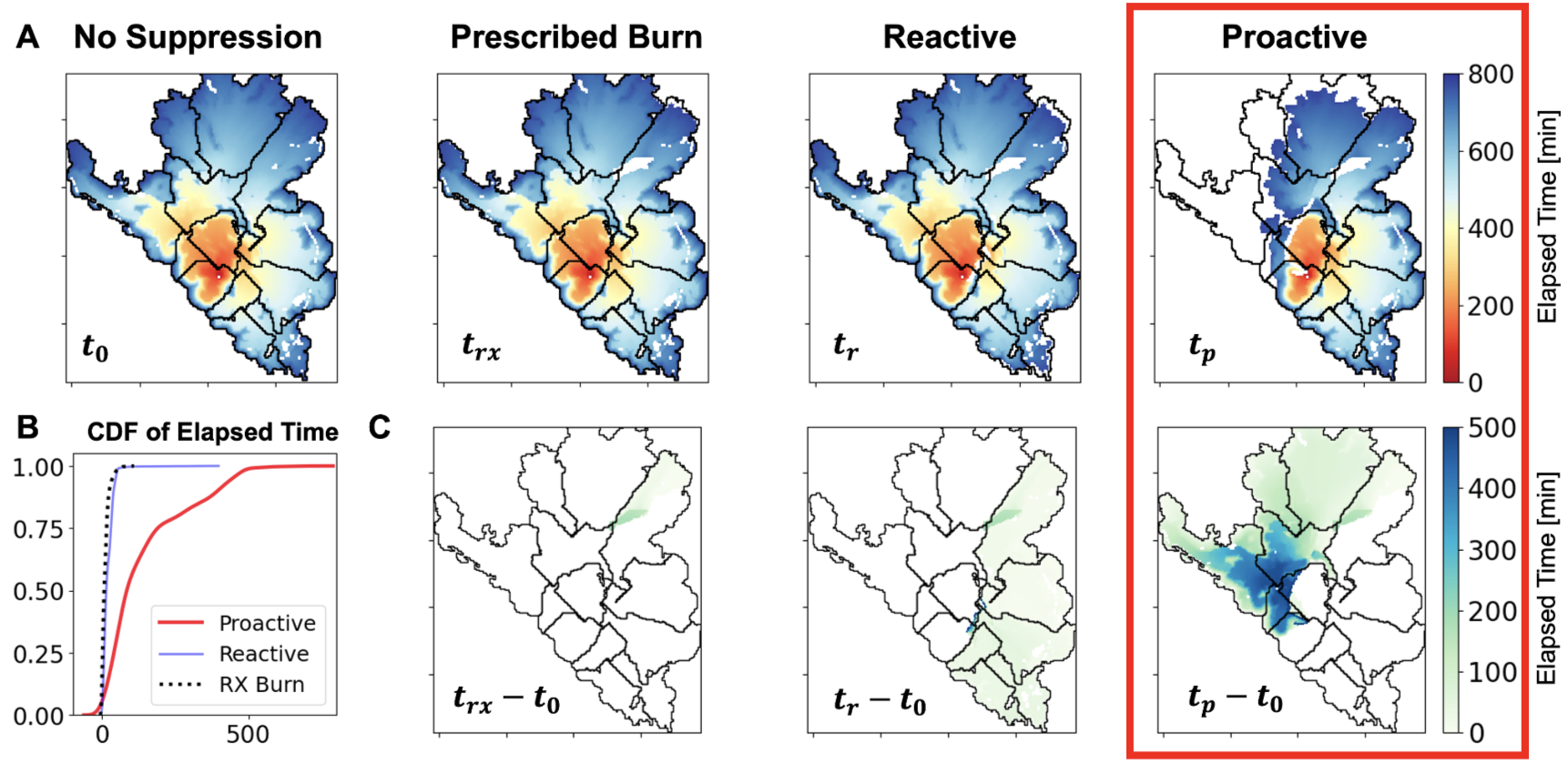
The reactive strategy (SR) suppressed the fire's right flank to slow eastward spread. The proactive strategy used fire potential polygon networks to (1) suppress the left flank to slow westward spread (tactics S1–S4) and (2) block potential new fire paths from emerging.
Proactive decision-making consistently achieved the most time gained against fire progression, enabling valuable windows for evacuation, resource deployment, and containment.
We compare elapsed time from the simulation without any interventions (t0), only prescribed burn (trx), and all tactics (prescribed burn and tactics S1 to S4). We also display cumulative distribution functions of the change in elapsed time for each tactic (trx and tp) against no suppression. We then measure the change in elapsed time following prescribed burn (trx - t0), all reactive tactics (tr - t0), and all proactive tactics (tp - t0). This shows that the proactive tactics are the only meaningfully effective set of tactics. The prescribed burn is useful, but only when combined with proactive suppression tactics.
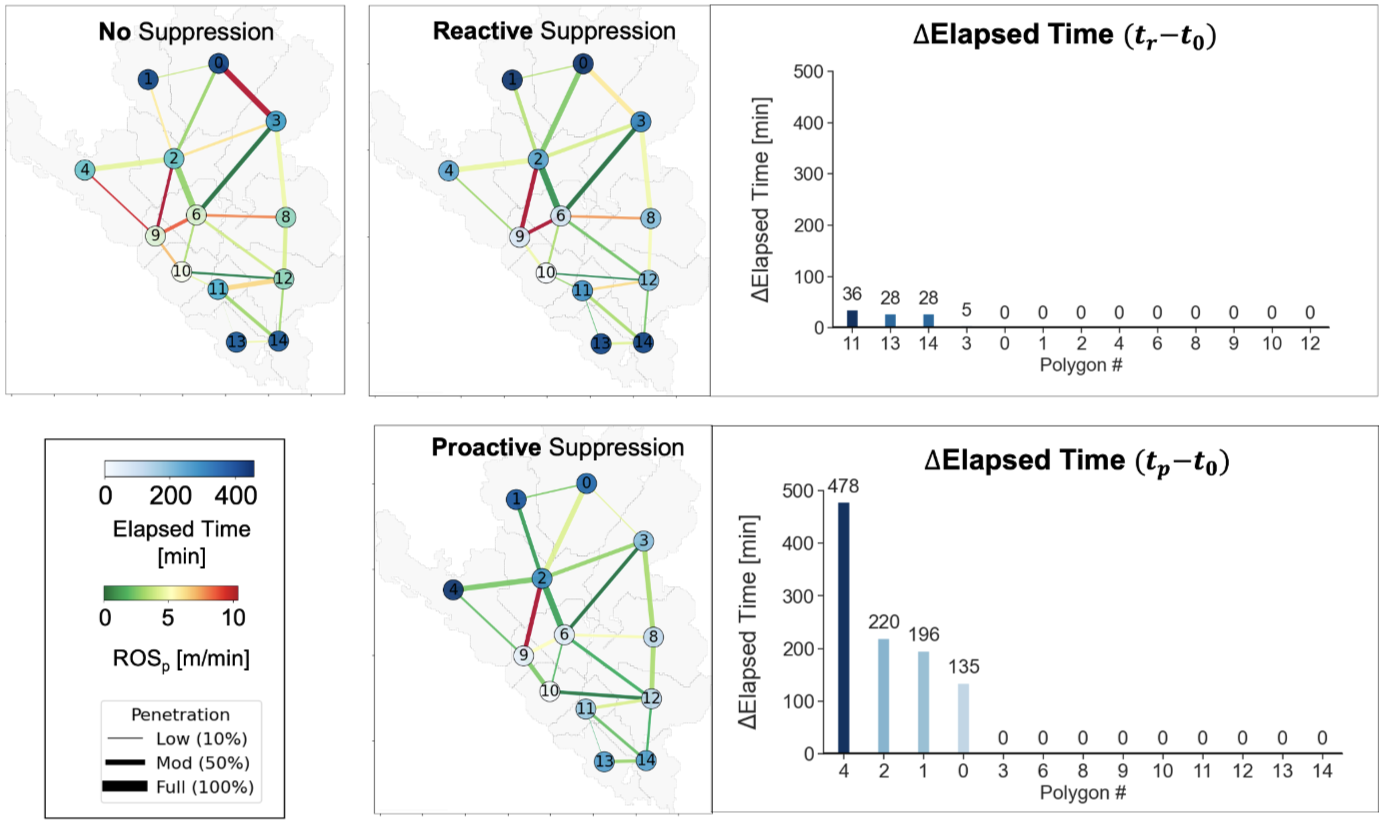
We then connect the polygons into networks. The pre-suppression network (“No Suppression”), post-suppression networks (“Reactive” and “Proactive” scenarios) are presented by elapsed time. The change in elapsed time plotted in descending order of polygons with the most time gained show most time gained with the top polygons highlighted in green. Similarly, we observe that the proactive tactics significantly reduces the rate of spread across polygons (network edges) and gains time (nodes), thus underscoring the importance of using proactive, risk-informed information.
Fire potential polygons and networks can revolutionize operational fire management to design proactive tactics that can significantly delay fire progression and gain valuable time for fire suppression.
References:
Castellnou et al. (2019). Empowering strategic decision-making for wildfire management. Fire Ecology, 15(1), 31.
Kim, Castellnou & González (2025). Modeling potential fire spread polygons and networks for suppression strategies. International Journal of Disaster Risk Reduction, 105853.