Fighting Fires with Wildfire Simulations
Wind plays a crucial role in fire behavior, yet most operational fire spread models assume constant wind. We couple Cell2Fire with WindNinja to produce downscaled, spatially-explicit wind fields — applied to the 2025 Palisades Fire's first 32 hours of most rapid spread.
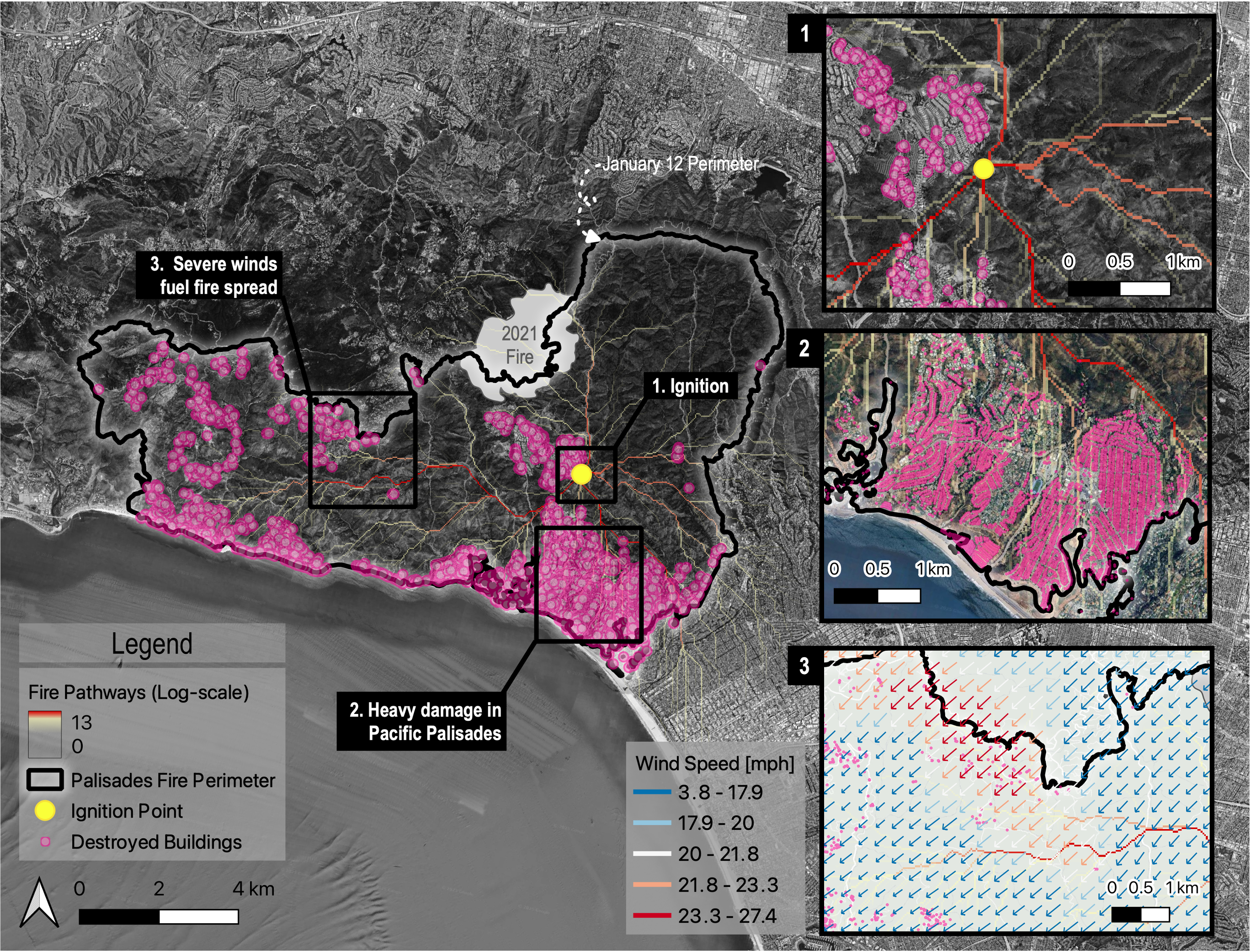
The Palisades Fire ignited on Tuesday, January 7, 2025, around 10:30 AM local time. Initial fire spread propagated to the south, heading southeast through a small canyon. Severe drought conditions (relative humidity <15%) and strong Santa Ana winds propelled fire spread and drove embers, leading to severe urban conflagration within the first 24 hours.
Following the initial spread southward towards the coast, the fire spread laterally westward on the lee side of mountains. Strong, sustained wind speeds and complex wind-terrain interactions pushed the fire further west. The first 32 hours exhibited the most rapid and consequential spread.
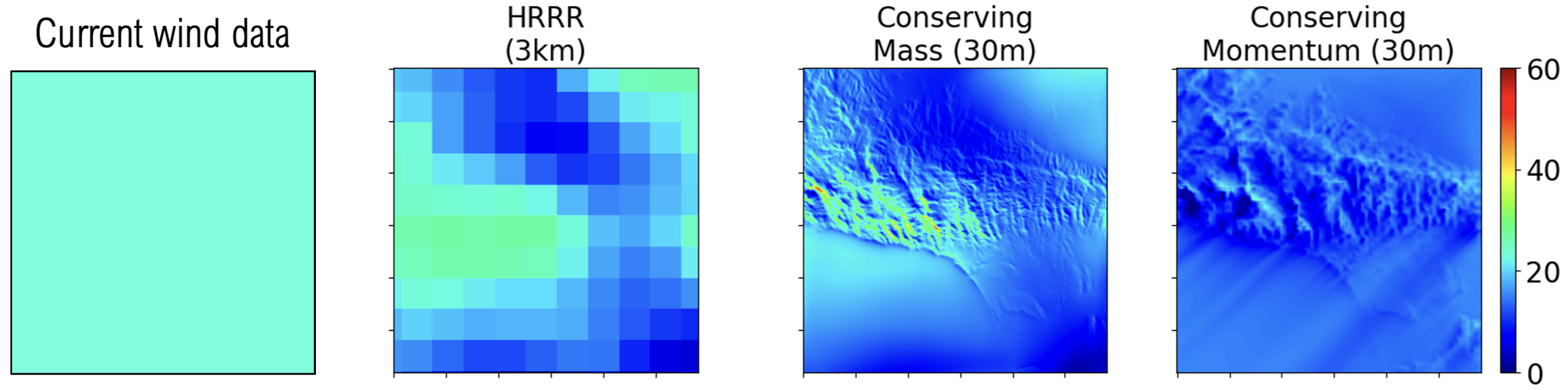
WindNinja generates downscaled wind field data at each temporal step in the Cell2Fire simulation. The two models are coupled "offline" because WindNinja interacts with Cell2Fire outside of the simulation logic, preparing spatially-explicit wind fields as inputs for fire spread simulations.
Wind data from the 3-km High-Resolution Rapid Refresh (HRRR) weather model are downscaled to 30-m resolution using WindNinja's physics-based solvers that conserve mass (and momentum). 32 wind field grids are produced for each solver type.
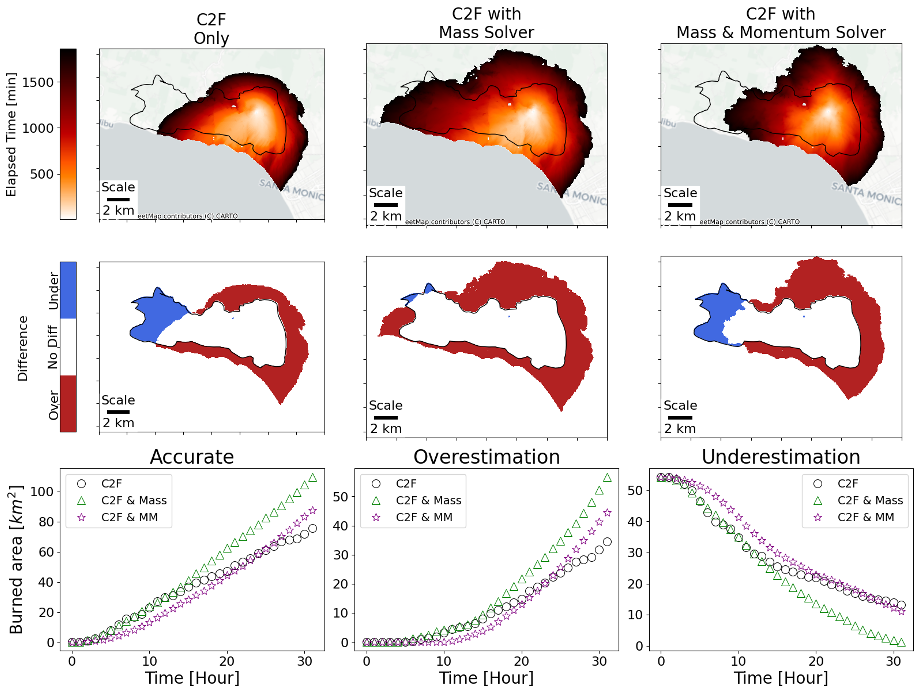
We then compare three simulation configurations: Cell2Fire only (C2F), C2F with mass solver (C2F-M), and C2F with both mass and momentum solvers (C2F-MM).
The C2F with mass solver (C2F-M) produced the best overall simulation. C2F-only and C2F with both solvers (C2F-MM) led to significant underestimation in the western direction. C2F-M recorded burned area pixels most accurately over time, though it also overestimated the most after ~15 hours.
Overestimation may be preferred for risk-averse decision makers. After 25 hours, C2F-MM became more accurate due to less overestimation, suggesting a potential hybrid approach.
In complex mountainous terrain, it is difficult to resolve turbulent flows that would occur in lee-slope directions. More sophisticated fire-atmosphere coupling or physics-based models are needed. However, these models are computationally costly and unsuitable in operational, real-time settings.
Offline coupling of Cell2Fire with WindNinja provides downscaled, spatially-explicit wind fields to improve simulations during the initial wind-driven major fire spread event (32-hour window).
References:
Kim, Pais & Gonzalez (2025). Fire spread simulations using Cell2Fire on synthetic and real landscapes. Scientific Reports, 15(1), 25173.
Pais et al. (2021). Cell2Fire: A cell-based forest fire growth model. Frontiers in Forests and Global Change, 4, 692706.
Wagenbrenner et al. (2016). Downscaling surface wind predictions from NWP models. Atmospheric Chemistry and Physics, 16(8), 5229–5241.