Are Extreme Fires Unprecedented or Unexpected?
The March 2025 wildfire in North Gyeongsang province, South Korea, was the most extreme and damaging fire in the nation's history. By benchmarking against global databases, we show that extreme fires can occur even in unexpected geographies.
Full paper coming soon!
South Korea is globally recognized for K-Pop, K-Drama, and K-Movies — not catastrophic wildfires. Yet the country has experienced continuous seasons of record-breaking fires: 2019, 2022, and 2025. The March 2025 wildfire in Uiseong-Andong county (North Gyeongsang province southeast of South Korea) was especially devestating, occuring months before the anticipated fire season. The fire became the most extreme and damaging in the nation's history.
The fire occurred months before the anticipated fire season. The fires spread into the wildland urban interface, driven by Foehn winds and extreme fire behavior. Although this region experienced wildfires in the past, this event exhibited unprecedented fire behavior highlighted by unprecedented fire spread on March 25 driven by pyroconvection and high winds. The impact was especially devastating as the fires led to 32 fatalities, over 5,000 buildings damaged, and more than 100,000 ha of burned area in a week. Many houses, farms, facilities, ecosystems, thousand-year-old temples, and national heritage sites were damaged, incurring an estimated 1.2 billion US dollars in required costs.
"This wildfire has exposed the reality of a climate crisis unlike anything we've experienced before."
Maximum daily fire spread (km²/day) is increasingly used to characterize "fast fires" which is highly linked with more destructive outcomes in the US. When compared to a 20-year global fire dataset (Mahood et al., 2022), the Korea fire ranks in the 99th percentile of the fastest-growing fires globally, underscoring how extreme yet unusual an event it was for this geography.
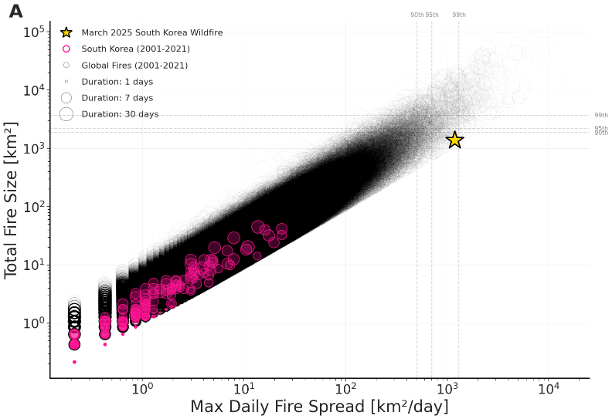
Benchmarked against the top-100 US megafires (Balch et al., 2024), the Korea fire is ranked as the 3rd fastest fire — faster than the 2018 Camp Fire, 2020 North Complex, and 2020 August Complex Fires in California.
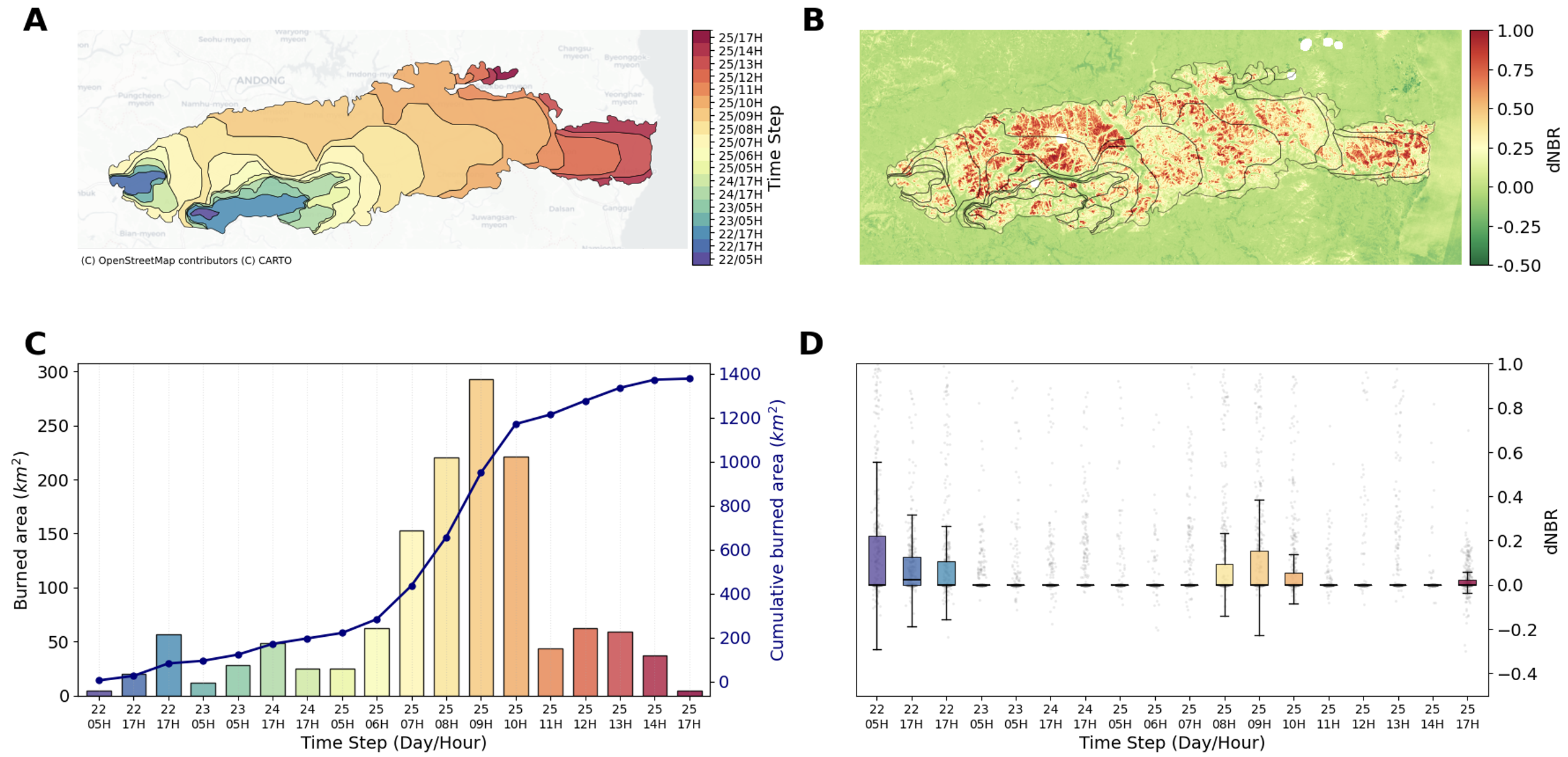
Fire progression was analyzed via temporal isochrones derived from satellite imagery. Burn severity was mapped using delta Normalized Burn Ratio (dNBR) from harmonized Sentinel-2/Landsat-8 imagery. Pre-fire imagery was compared with post-fire imagery acquired on April 1 and 8, 2025.
The fire's progression shows initial spread southward in the first 24 hours, followed by rapid expansion as wind conditions intensified.
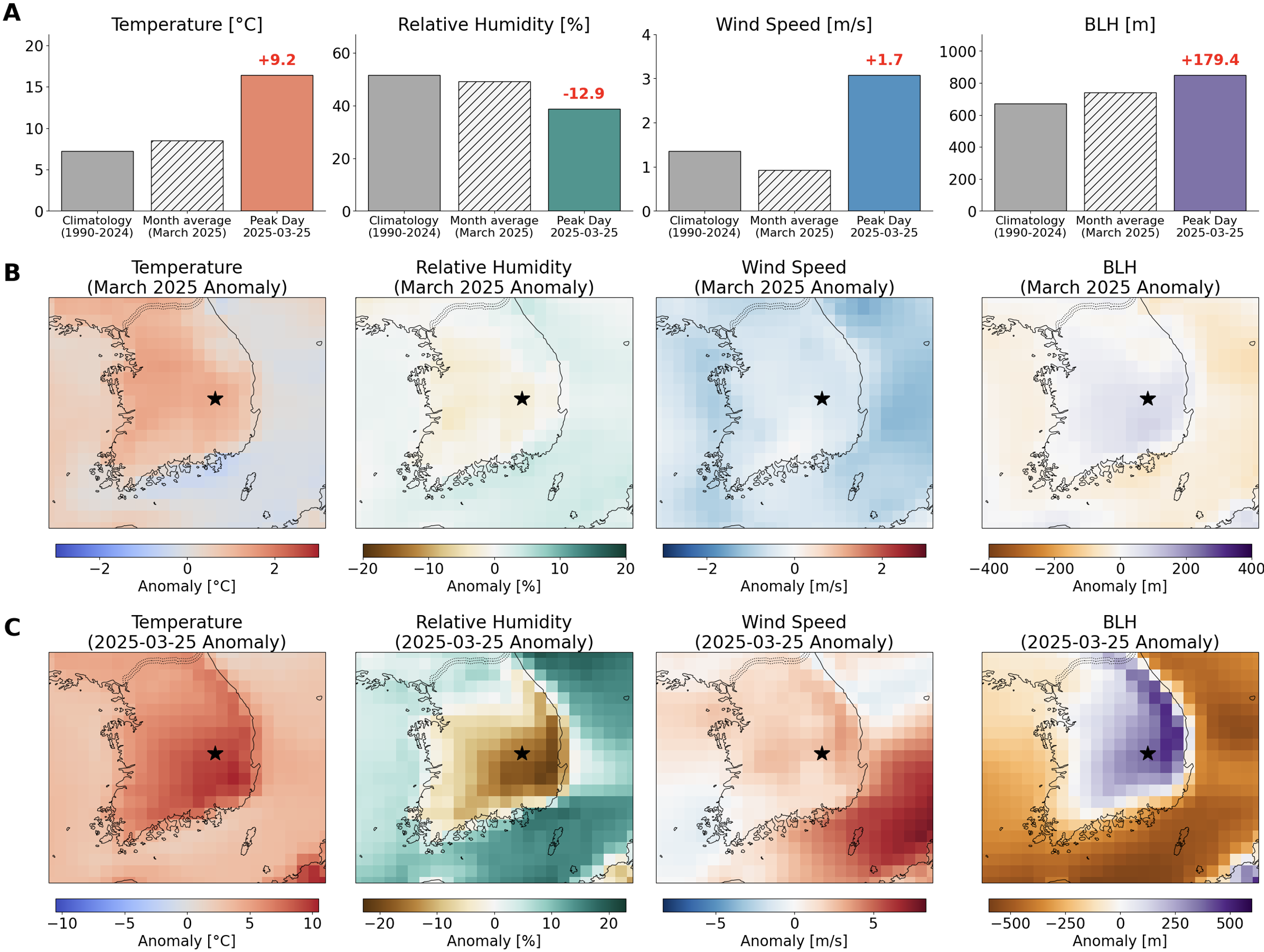
Fire weather conditions were compared against a 35-year climatology (1990–2024). Temperature anomaly reached +9.2°C above the March baseline, relative humidity was −12.9% below normal, wind speed was +1.7 m/s above average, and boundary layer height (BLH) was +179.4 m above baseline — all simultaneously on the peak fire day (March 22).
Monthly and peak-day anomaly maps confirm that the fire was driven by concurrent extreme fire weather conditions that deviated significalty from historical norms across all variables.
Korea’s recent wildfire exhibited unprecedented, extreme fire behavior, but prior history of highly extreme SFW conditions suggest this worst-case scenario was unusual yet not completely unexpected.
References:
Balch et al. (2024). The fastest-growing and most destructive fires in the US (2001 to 2020). Science, 386(6720), 425–431.
Mahood et al. (2022). Country-level fire perimeter datasets (2001–2021). Scientific Data, 9(1), 458.